
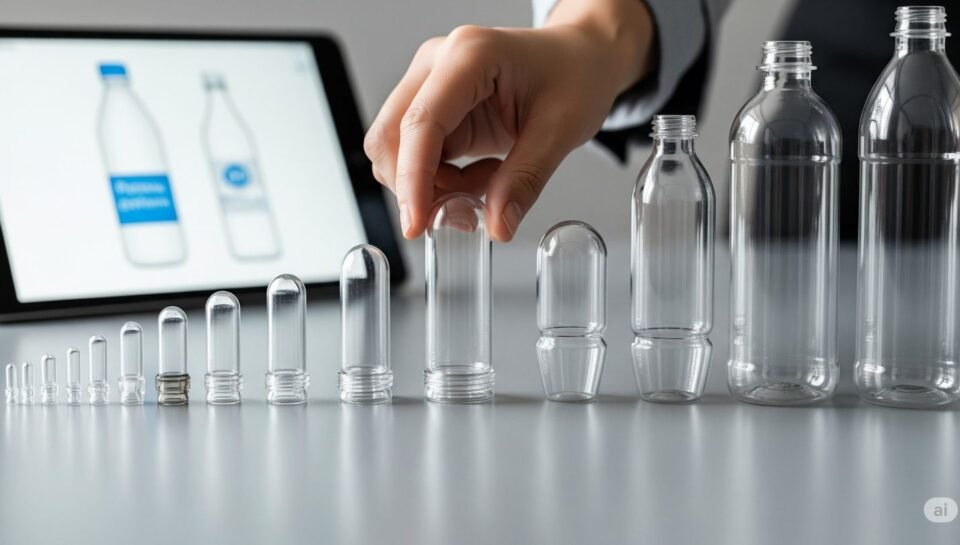
No matter what you are packaging, whether it is beverages, oils, or pharmaceuticals, when it comes to Plastic Preform Packaging, the size really does matter! We’re not talking about the size of the final bottle; we are talking about the actual size of the PET Preforms. The size of the preform directs each aspect of the bottle, including the shape, capacity, durability, and appearance. Choosing the wrong PET preform size can lead to leaking products and other production problems.
With competition in India’s FMCG and packaging markets at an all-time high, manufacturers are continually looking for ways to optimize their design of PET preforms to ensure maximum strength and minimum cost, while maintaining a perfect fit with the finished product. The problem is that many buyers, especially first-timers, do not have a full understanding of how preform dimensions affect the overall bottle manufacturing process.
This article will provide you with everything you need to know about PET Preform sizes, how to interpret PET Preform size numbers, what the standard preform sizes are, and how to select the right size for your product line. By following this information, you will be able to buy PET preforms with the utmost confidence, while also sourcing more efficiently and saving money!
Table of Content
- What Is a PET Preform? Quick Recap Before We Dive In
- Understanding PET Preform Sizing: It’s Not Just About Weight
- How to Choose the Right PET Preform Size for Your Product
- Custom vs. Standard Preform Sizes: What Should You Choose?
- Small Bottle vs. Large Bottle Preform Sizes: The Key Differences
- The Cost Factor: How Preform Size Impacts Pricing
- Mistakes to Avoid When Sourcing by Size
- BIS Recommendations for PET Bottle Dimensions in India
- Lightweighting: Can You Reduce Preform Size Without Losing Strength?
- The Impact of PET Preform Sizes on Blow Molding Efficiency
- Final PET Preform Size Selection Checklist for Smart Buyers
What Is a PET Preform? Quick Recap Before We Dive In
Let’s first review the fundamentals before we get into the particulars regarding this method of production. A PET Preform is a semi-finished piece of plastic manufactured using PET resin, commonly known as an injection mold test tube. Originally molded into a tube like a test tube, these preforms are subsequently reheated and blown radially, whereby they are turned into their final form (i.e., bottle) through an injection molding process.
The two-step manufacturing process utilized by many manufacturers, it offers the manufacturer the ability to quickly produce thousands of identical shapes in one location, allowing for easy transport to any given location where they will be shaped and ultimately turned into the actual products themselves, enabling the quickest and least expensive production of their finished goods.
Common knowledge suggests that the design process of a PET preform includes:
- Cap – The neck modification is what determines the style of cap fitted onto the bottle.
- The bottle will begin in the shape of a preform and finish in an expanded form.
- Preform will have a specific gram weight based on how much resin is used in the production of the piece, and will therefore determine the thickness of the walls on the bottle.
As well as the worldwide increase in the demand for recyclable, economical, and diverse products for packaging (e.g., beverage/oil/pharmaceutical/drugs) manufactured from PET preforms, as noted by the International Materials Research Corporation (IMARC), with India’s production capacity at over 3400 kiloton, also known as FY22.
In short, A preform serves as the basis from which the products are produced, and the sizing of a preform is the basic requirement for production.
Understanding PET Preform Sizing: It’s Not Just About Weight
Many new buyers mistakenly believe that PET preform sizes are only determined by weight. But while the weight is certainly important when determining how much PET will be used to manufacture a bottle, three distinct parameters determine a PET preform’s size:
1. Gram Weight
This is the actual weight of the preform (measured in grams). The gram weight of a preform affects how thick and strong the resulting bottle will be. For instance:
- A 9g preform can produce a 250ml polyurethane bottle.
- A 20g preform can produce a 1L carbonated beverage bottle.
2. Neck Diameter
This refers to the “mouth” of the bottle, i.e., the size of the neck and the type of closure (cap, seal, etc.). For example:
- A 28mm Alaska neck is the most common size for water bottles.
- A 38mm neck is used for bottling products such as juices and/or oils.
3. Length of Preform
The length of the preform dictates the maximum height that the bottle may stretch. Longer preforms can produce taller bottles with larger volumes than shorter ones.
Therefore, when we discuss the “standard sizes of PET preforms,” we are actually discussing the three variables discussed above, and using the wrong combination can harm everything from bottle compatibility to efficiency of the blow moulding process.
4. Common PET Preform Sizes in the Indian Market
The packaging industry in India is diverse regarding the types and sizes of PET preforms used based on product types and target markets. Gujarat, Maharashtra, and Tamil Nadu have especially larger quantities of diverse sizes of preforms available for use than other regions in India.
The following is an example of popular size pairings of preforms found within India:
| Bottle Volume | Preform Weight | Neck Type | Typical Use |
| 200ml | 8–9 grams | 28mm Alaska | Water / Juice Bottles |
| 500ml | 11–13 grams | 28mm Alaska / PCO | Water / Flavoured Drinks |
| 1 Litre | 19–23 grams | PCO 1810 or 1881 | Carbonated Drinks / Oils |
| 2 Litres | 28–32 grams | 3-Start / Wide Neck | Soda / Edible Oil |
| 5 Litres | 50–70 grams | 38mm or Wide Mouth | Bulk Water / Oil Packs |
What does this mean? If you’re launching a new product, using standard-size PET preforms will allow you to utilize existing moulds, get competitive prices, and allow easy compatibility with existing caps.
Standard-size preforms are beneficial to the industry because they’re designed for use on automated filling machines and utilize caps that are readily available in all regions of India.
5. Neck Sizes Explained: Alaska, PCO 1810, PCO 1881, 3-Start & More
Although small, the neck size is a critical emerging part of PET preform design. The neck plays an important role in the following:
- The type of closure and cap to be used
- The bottle´s ability to hold pressure
- The optimum position of labels and sleeves
There are several PET preform neck sizes used in packaging in India, including the following examples:
28mm Alaska Neck
- Commonly used for still water & juice products
- Fairly lightweight & cost-effective
- Not recommended for product packaging containing carbonation
PCO 1810
- Designed for high pressure and heavy-duty carbonated beverage packaging.
- Ideal for a variety of products from sodas to sports drinks.
- Vented cap included with low-pressure option.
PCO 1881
- The lightweight version of the PCO 1810 series, these preforms are used to minimize costs while maintaining similar strength attributes.
- Works well for carbonated soft drinks as well as flavoured water.
3-Start Neck
- These closures have been designed for tamper-evident packages and can provide added grip while protecting the contents from tampering.
38mm / Wide Mouth
- These neck sizes are most commonly found in 5-litre jugs and packaging for edible oils.
- Wide mouth allows for high volume pouring & filling operations, which increases throughput and reduces costs.
Selecting the correct neck size when designing a PET preform is essential to reduce leakages, increase shelf-life, and maximize efficiency on production flooring.
How to Choose the Right PET Preform Size for Your Product
Your choice of PET preform size will be the combination of strategic considerations and the scientific determination of what best suits your product. Whether you are bottling water, oil or pharmaceuticals, it is imperative to select a preform that is compatible with your production, shipping and retail display.
To assist with the decision-making process, please refer to the following.
| Factor | What to Consider |
| Bottle Volume | 200ml? 500ml? 20L? DRJ offers preform weights from 6.2g to 700g |
| Neck Type | Alaska for water, Short Neck (26/22) for oils, 55mm for bulk water |
| Filling Method | Is your line high-pressure? Opt for thicker preforms (13g–20g) |
| Storage Needs | Long shelf life = stronger bottle walls = heavier preforms |
| Cap Compatibility | Make sure your cap supplier matches the neck size (thread count, height) |
Custom vs. Standard Preform Sizes: What Should You Choose?

Brands often find themselves in a dilemma about whether to use the standard size preform for PET (Polyethylene Terephthalate) or to create a custom mould.
Standard PET Preform Sizes (such as 9.4g/28mm “Alaska” or 18g/28mm “short neck”) may be a good choice for you if:
- You want to receive your order in a short period of time
- You are using standard filling/capping lines to package your products
- You are looking for low upfront costs
Conversely, Custom PET Preforms may be worth the investment if:
- You are launching a new product line that requires packaging or shelf specifications that are not covered by standard sizes
- You are looking to have your brand’s name and logo placed on the neck or thread of the preform
- You are using unique closure systems (for example, tamper-evident closures, shrink sleeves, etc.)
Small Bottle vs. Large Bottle Preform Sizes: The Key Differences
Even though the small bottles and large bottles can have the same ultimate consumer, they will have a different production process and manufacturing requirements, and this is reflected in the PET preform sizes.
Small Bottles (200mL-1L):
- Preform Weight Ranges: 6.2g to 20g
- Neck Types: Short Neck (26/22), Alaska (28mm)
- Applications: Water, Soft Drinks, Juices, Pharmaceuticals
DRJ Offers:
- 6.2g, 6.5g, 9.4g, 9.5g Short Neck (26/22) PET Preforms
- 7.8g, 8.8g, 12g, 13g Alaska Neck PET Preforms
The Wall thickness and neck concentricity must be maintained accurately to ensure a Stable Bottle and Consistent Sealing.
Large Bottles (5L-20L):
- Preform Weight: 640g to 700g
- Neck Type: 55mm Wide Mouth
- Applications: Bulk Drinking Water, Oil Dispensers
DRJ Offers:
- 640g, 660g, 700g PET Preforms for 18L-20L bottles
The Larger preform will require a Strong Mould Integrity and High Quality of Resin to avoid blowing out or Warping.
The Cost Factor: How Preform Size Impacts Pricing
Let’s talk about how preform size impacts packaging costs. You may think that heavier preforms equal better quality, but this isn’t always the case when it comes to making a smart business decision.
The following information clarifies how PET preform pricing in Gujarat:
- Weight: The more grams a piece of resin has, the greater its cost per pound and due to its weight, the cost per unit will increase as well.
- Neck Complexity: Generally speaking, moulding short necks and Alaska necks is less expensive than moulding wider-neck PET preforms.
- MOQ: The larger orders companies place, the lower the per-unit pricing will be.
- Material: High-quality, virgin PET from reputable manufacturers will incur a higher cost than using unbranded or cheap imported blends.
- Quality Inspections: Manufacturers such as DRJ who inspect preforms twice daily for visual, thread, and base thickness will likely charge a little higher, but this integrated quality control will end up saving you from product failures in the long run.
On average, 12-20 grams of PET preforms will run somewhere between ₹1.00 and ₹2.50 per piece, depending on specs and volume purchased. On the other hand, large volume bubble tops greater than 640 grams will run somewhere between ₹14.00 and ₹18.00 each.
Mistakes to Avoid When Sourcing by Size

Selecting the inappropriate PET preform dimensions can gradually deplete your financial resources, decrease production efficiencies and shorten shelf life. It may be tempting to base your choice solely on weight, but there are several other factors involved in sourcing the best preforms for your application. Below are types of errors to avoid:
Using the same preform across multiple product categories: Preforms created for still water will likely not fit well with preforms for carbonated beverages or food oils.
Disregarding thread compatibility: Bottles for carbonated beverages require both the same diameter as the cap and also the same standard of thread pattern. Using an Alaska neck with a carbonated beverage is an example of such a mismatch, which results in leakage and burst defects.
Believing that a heavier preform equals a stronger preform: While a 13g preform may be able to hold a 500ml bottle comfortably, a move up to 15g does not necessarily translate into more strength; it could just be an excess expense for no added benefit.
Not validating the preform size on your filling line: The preform size you select will have an impact on the volume of the finished product and the capping process. What works in one production facility may not work in a different plant.
Skipping supplier quality assurance checks: The dimensional tolerances, neck concentricities, and IV values may be very different among the various suppliers you work with. Only utilize pet preform manufacturers that provide a periodic quality assurance program and appropriate documentation, including dimensional tolerances, neck concentricity, and IV value.
The details of the preform, including neck finish and length, will all make a difference. Your final selection of a balanced preform must be based on actual specifications.
BIS Guidelines for PET Bottle Sizes in India
Knowing BIS standards is essential if you work in India’s regulated FMCG or pharmaceutical packaging industries. To guarantee that PET bottle packaging is hygienic, safe, and dimensionally dependable for consumer use, the Bureau of Indian Standards (BIS) establishes regulations.
What you should know is as follows:
- The two main standards governing PET preform design for food-grade and water-grade bottles in India are IS 12252 and IS 14534.
- Neck sizes and tolerances: To prevent cap mismatch problems in the field, BIS advises uniformity in neck threads and sealing surfaces.
- Material safety: Only food-grade PET resins with restrictions on migration, clarity, and acetaldehyde levels should be utilized.
- Tamper-evidence and closure compatibility: Preform necks must enable consumer-friendly, safe, and secure sealing.
Brands can more easily comply with the Beer Institute by choosing preforms produced by manufacturers that produce 26/22 short-necked preforms (26/22 with short necks, 28mm Alaska, and 55mm wide mouth preforms). This is especially important when supplying products to regulated industries (e.g., bottled water, edible oils, and pharmaceuticals).
When selecting preform sizes, manufacturers should ensure that the preform design is in alignment with BIS-approved standards.
Lightweighting: Can You Reduce Preform Size Without Losing Strength?
PET packaging has been transformed by the idea of lightweighting. It’s the art (and science) of cutting preform weight without compromising performance, strength, or clarity.
This is how it operates:
- Lighter bottles and caps are made possible by neck redesigns like the 26/22 short neck, which is particularly perfect for water PET packaging.
- Thanks to optimized cooling and injection cycles, advanced mould precision guarantees that thinner wall sections are still structurally sound.
- Selecting high IV (Intrinsic Viscosity) resins helps preserve strength in lighter preforms.
Today, many brands have transitioned to 9.4 gram, Short-neck (Pre-forms) Pre-forms to lower costs per unit on 500 mL Products. The 9.4 gram, Short-neck (Pre-forms) Pre-forms are also able to perform as well on shelf as a 13 gram, Neck. As a benefit, Brands support Sustainability because they reduce the use of Raw Material and Carbon Foot-Print.
As manufacturers offering Precision Weight Control and Minimum Neck Standardization assist brands in the transition to Lighter Preforms, manufacturers must conduct Tests on existing Blow Moulding and Filling Lines to ensure that a lighter pre-form will not lead to performance issues.
How PET Preform Sizes Affect Blow Moulding Efficiency
PET preform size directly affects your blow moulding performance; it’s not just about PET packaging aesthetics. Here’s how:
- Stretch ratio and final bottle height are influenced by preform length. Weak bottoms or malformed necks can result from a mismatch.
- Consistency in wall thickness guarantees consistent stretching, which is essential for strength and clarity, particularly for transparent water or oil bottles.
- Capping, orientation, and sleeve alignment are all impacted by neck design. For instance, in many water lines, short neck 26/22 preforms provide quicker cycle times.
- Size and weight have an impact on the heating temperature settings. A 640g wide neck preform might require much higher settings than a 12g Alaska neck preform, which might require 105°C.
Selecting the appropriate preform shape and size aids in reducing:
- Heating-related energy consumption
- Scrap rates as a result of bottle failures
- Delays in cycle time
Final PET Preform Size Selection Checklist for Smart Buyers
Make sure you’re selecting the correct size, not just the right price, by going over this short checklist before you sign off on your next PET preform purchase.
Complete Use Case
- Carbonated or still?
- Water, pharmaceuticals, oil, or makeup?
Bottle Volume Target
- 200 ml, 500 ml, 1 L, 5 L, or 20 L?
Type of Neck Finish
- Alaska for water at 28 mm
- 26/22 Short Neck for medications or juices
- Bulk PET packaging with a 55 mm wide neck
Accuracy of Weight
- Use the appropriate gram weight to match the strength and cost of the resin.
Machine & Mold Compatibility
- Make sure your current ISBM machines can run the preform.
Adherence to Regulations
- Are BIS and food-grade PET resin requirements satisfied?
Tested Sample
- Prior to mass production, always ask for a few trial runs.
Transparency and Quality of Resin
- Is the resin pure? Are AA and IV levels within acceptable bounds?
It makes all the difference to work with manufacturers who are aware of how PET preform sizes, product application, and cost-efficiency interact. Our specialty at DRJ Plasttech Private Limited is providing PET preform products that are optimized for cost, weight, and performance, in addition to being precision-engineered.
Whether you require 700g wide necks or 6.2g short necks. With our extensive portfolio, reliable quality, and support for customization, we enable brands of all sizes to grow more intelligently, quickly, and economically throughout India.