
The production of PET preforms is a process that necessitates precision. Be it a mass production of thousands of units per day or a custom design, a single miscalculation could result in expensive idle time, inferior quality, and dissatisfied customers.
Through working with DRJ Plasttech, I’ve had the opportunity to see everything from surface flaw issues to performance-related failures. As such, the good news is that most of the common problems associated with PTE preforms have solutions. In this article, we will identify the seven major types of production problems with PET preforms and share ways to rectify the issue quickly.
Table of Contents
When PET Preform Production Doesn’t Go as Planned
2. Short Shot (Incomplete Fill)
4. Black Spots and Contamination
5. Crystallinity Issues (Hazy or Brittle Preforms)
7. Thread or Neck Finish Defects
DRJ Plasttech’s Approach to Preventing PET Preform Production Issues
Final Thoughts: Don’t Let Preform Problems Hurt Your Bottom Line
Want help with your current production setup or sourcing top-quality PET preforms?
FAQs about PET Preform Production Problems
When PET Preform Production Doesn’t Go as Planned
This guide is intended for Managers and Supervisors in Procurement and Operations who deal with PET Preform production. This guide will outline the basic 7 problems faced when producing PET Preforms. These problems are not listed in order of frequency or importance.
1. Flash Formation
The Issue: Excess plastic found along the parting line of a preform can result in sporadic ridges or wings being produced.
What causes it:
- Worn or misaligned moulds
- High Injection Pressure
- Insufficient clamping force
Fix it fast:
- Evaluate and align the mould core and mould cavity
- Re-evaluate the injection pressure settings
- Evaluate and check the hydraulic system to ensure consistent clamping pressure
DRJ Pro Tip: Fixing flash early helps eliminate future sealing issues during blow moulding. Fixing flash form problems on the mould results in significant cost savings due to rework.
2. Short Shot (Incomplete Fill)
The Problem: The preform does not fill the mold resulting in either part of the preform collapsing or incomplete filling of each cavity.
What causes it:
- Low Barrel Temperature
- Low Injection Pressure and Speed
- Obstruction in the Gate/Runners
Fix it fast:
- Increase Melt and Mould Temperatures by a Small Amount
- Ensure all runners/Gates are Cleaned Out Completely
- Adjust Injection Profile for Better Material Flow
DRJ insight: short-shots can kill an entire batch of material. Routine cleaning and temperature checks of the runner channel/base will help to prevent these types of issues from occurring.
3. Bubbles and Voids
The problem: Affects clarity and integrity due to small bubbles of air trapped within the preform.
What causes it:
- Moisture in the resin
- Inadequate venting
- Excessive backpressure
Fix it fast:
- Dry your resin using the pre-drying method of 160°C-180°C (4-6 hrs depending on material).
- Review the design of the mould for adequate venting.
- If foaming continues after increasing venting, reduce backpressure.
Expert Tip: Bubbles are a common result of inadequate drying practices. At DRJ Plasttech, our systems utilize a state-of-the-art resin drying system to prevent this during bulk production.
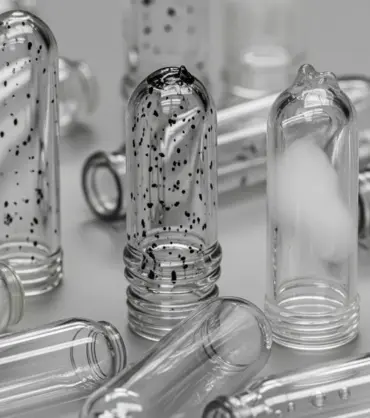
4. Black Spots and Contamination
The problem: Dark specs/streaks on PET preform surfaces decrease visual appeal & safety.
What causes it:
- Contaminated or recycled PET
- Excessively long resin residence time (burnt resin)
- Poor screw & barrel cleaning
Fix it fast:
- Always use food-grade resin certified for water bottle use
- Regularly clean the hopper, screw, and hot runner
- Don’t use degraded or off-spec regrind/feedstock
Why it’s important: Inconsistencies may fail FDA/ISI compliance testing, which no water bottle manufacturer can risk.
5. Crystallinity Issues (Hazy or Brittle Preforms)
The Problem: The preforms are not produced as clear and impact-resistant products but as foggy and very brittle.
What causes it:
- Incorrect cooling cycles
- Mould temperatures are set too hot or too cold
- The melt phase temperature was too high
Fix it fast:
- Lowering the temperature of the mould (to 20 to 30 degrees) will increase clarity.
- Adjust how long you BLOW mould and cool.
- Keep the melt temperature at a consistent level in the range of 270 – 280 degrees Celsius (for most PET grades).
Expert tip from DRJ Plasttech: When your customers receive the product, they are judging quality based on its appearance. Foggy-looking products can create issues during the subsequent blow moulding process and weaken shelf appeal. By automating your systems to record the melt and mould temperatures to the degree, you eliminate the guesswork!
6. Uneven Wall Thickness
The problem: An inconsistency in the thickness of blow-moulded preform containers creates a thicker or thinner area on the container wall than normal, making the finished bottle weak.
What causes it:
- Misalignment of core pins,
- Worn-out cavity pieces (eg, cavity plates/cavity foils, etc),
- Poor melt flow during the injection process.
Fix it fast:
- Recalibrate the alignment of the core(s) and cavities,
- Inspection of the moulds to determine if they are worn out, and replacement of any critical components,
- Optimize the injection attack profile to improve the consistency of the filling of the preform.
DRJ advantage: We perform ultrasonic alignment checks on moulds and sample parts throughout our production runs; therefore, we keep the wall variance of any container less than 1%.
7. Thread or Neck Finish Defects
The Problem: Capping, sealing, and fitting of containers produced on a blow-moulding machine can be affected by deformations or inconsistencies in the area of the neck.
What causes it:
- Non-Conformance to mould alignment
- Excessive injection pressure is applied to the neck ring
- Core shifts during mould closure.
Fix it fast:
- Checking the neck ring for wear or damage, if necessary, replace it.
- Equal injection pressure support at the neck ring level for the entire neck ring circumference.
- Reinforcing the mould guide pins to prevent deflection of the core.
Note from DRJ: The neck area of preforms for water bottles is a very important part of the process. Some very slight issues with the threads on the bottle will cause rejects from the capping line. We always work to keep the neck ring specs within ± 0.05 mm deviation.
DRJ Plasttech’s Approach to Preventing PET Preform Production Issues
DRJ Plasttech believes that the best way to prevent problems is to be proactive. We manufacture PET preforms through a combination of automated machinery, well-defined quality assurance processes and procedures, and inline monitoring systems that enable us to conduct on-site inspections of all preforms before shipping. All dimensional characteristics, wall thicknesses and optical colour clarity of our preforms are evaluated by our facility’s real-time inspection systems before shipping.
Your business is not just about ordering preforms from us. When you partner with us, you get a team of professionals dedicated to producing products of the highest quality.
Final Thoughts: Don’t Let Preform Problems Hurt Your Bottom Line
If your PET preform problems occur, they not only have the potential to cost you money (in wasted materials, rejected bottles, shut-down productions, and dissatisfied clients) but also may be solved or at least avoided by executing proper process controls throughout the production process, training all individuals involved with the project, and only working with reliable suppliers.
Need a PET preform partner with an understanding of your production challenges? Count on DRJ Plasttech! DRJ Plasttech has established itself as a premier manufacturer of PET preforms due to its outstanding technical service and superior consistency in its manufacturing process in Gujarat and surrounding states.
Want help with your current production setup or sourcing top-quality PET preforms?
Contact our technical team to discuss how we can support your operations. Or request a free sample batch of our most popular water bottle preforms.
FAQs about PET Preform Production Problems
1. Which PET preform production issues are most prevalent?
Short shots, flash, haze or brittleness, inconsistent colour, uneven wall thickness, and flaws in the neck or threads are some of the most frequent issues with PET preforms. Poor process control, worn moulds, or incorrect machine settings are frequently the cause of these problems.
2. How can short-shot problems in PET preform production be resolved?
When the cavity isn’t filled during injection, short shots typically happen. Increasing injection pressure, looking for material obstructions, and looking for hot runner system leaks are ways to troubleshoot this.
3. Why do my PET preforms seem brittle or hazy?
Usually, this is a crystallinity problem brought on by overheating during the melt phase or improper mould temperature. Clarity and strength can be increased by modifying the cooling period and lowering the melt temperature.
4. What makes PET preform molds flash?
Flash, or the extra plastic surrounding the parting line, is frequently caused by improper mould alignment or high injection pressure. It can be avoided with regular mould maintenance and appropriate clamping force settings.
5. How can I stop preforms from having uneven wall thickness?
Inconsistent wall thickness in PET preform production is typically caused by misaligned moulds or worn-out cavity components. Make sure the mould’s components are in excellent shape and that the core pins are positioned correctly.
6. What should I do if the preform’s neck finish is flawed?
Problems with neck finish can interfere with bottle sealing and capping. Verify the alignment of the mould, minimize core deflection, and look for wear or damage on the neck ring.
7. How does PET preform troubleshooting involving mold maintenance?
Maintaining mold regularly is essential. While wear inspection guarantees dimensional accuracy and minimizes downtime from recurrent preform production problems, clean molds prevent contamination.
8. Can issues with PET performance be caused by low-quality raw materials?
Indeed. Defects like discoloration, bubbles, and poor mechanical qualities can be caused by impure or low-grade PET resin. PET should always be purchased from reputable vendors, and drying procedures should be followed consistently.
9. Does automation help prevent production defects in PET?
Of course. Real-time monitoring and automated vision systems significantly lower human error, increase consistency, and identify problems like surface imperfections or short shots before they affect large batches.
10. How can DRJ Plasttech assist with troubleshooting PET preforms?
At DRJ Plasttech, we proactively address PET preform production challenges by combining state-of-the-art machinery, strict quality control, and technical know-how. Reduced downtime, dependable performance quality, and professional advice to maximize their operations are all advantages for our clients.